
In extensive industrial construction, chemical manufacturing facilities, and heavy machines fabrication, precise deployments outline the safety of structures. It is vital for mechanical engineers and procurement specialists to have reliable information on metric thread pitch and weight when it comes to loading cargo, calculating dead weight, or determining engagement force.
Being one of the top manufacturers of bolts, Stainless Bolt Industries Pvt. Ltd. specializes in high-end precision-quality threaded products, which are manufactured according to international standards. An understanding of how characteristics such as thread pitch, rod length, and composition impact total weight of SS DIN HEX BOLT and clamping strength is essential for engineering teams to optimize their machine assembly process as well as the expenses connected with freight movements.
Why Thread Pitch and Weight Specifications Are Important
It is crucial to understand that picking a correct bolt specification entails more than just having the right nominal diameter and length. If some of the threads’ pitches do not correspond, this could cause thread stripping, cross-threading, or insufficient clamping force when stress is applied.
At the same time, the accurate calculation of bulk weight of thousands of heavy hex bolts is vital for load distribution in any steel support structure, compliance with weight restrictions of cargo containers, and thus enables accurate budgeting of bill of materials (BOM) at the construction site.
1. Normal Coarse versus Fine Metric Thread Pitch
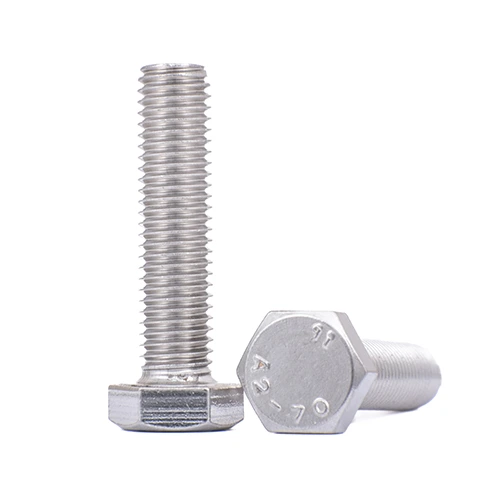
The metric threaded fasteners are specified according to their nominal diameter and pitch (pitch is defined as the distance between one crest of thread to the other, in millimeters along its length).
- Coarse Metric Pitch (Normal): The normal pitch of structural fasteners is used (e.g., M10×1.5, M12×1.75, M16×2.0). Coarse threads give advantage of easy installation and high resistance to thread damage from excessive handling.
- Fine Metric Pitch: A smaller distance between the crests is offered (e.g. M10×1.25, M12×1.25, M16×1.5). Fine threads provide a greater tensile stress area, improved adjustment accuracy, as well as stronger resistance to vibration causing loss of tightening in dynamic applications.
2. The difference between Full Thread DIN 933 and Half Thread DIN 931
To distinguish between body weight as well as thread geometry, one must be able to determine the exact Standard upon which SS 304 HEX BOLT or SS DIN933 HEX BOLT is manufactured.
- DIN 933 (ISO 4017) (Full Thread): The threading runs from the chamfered end until the underside of the hex head. This is appropriate for creating assemblies with tapped holes and for surface mounting.
- DIN 931 (ISO 4014) (Half Thread / Partial Thread): The factor that is present in this is that there is a smooth unthreaded shank under the head prior to the start of the thread. The smooth unthreaded shank gives the maximum shear resistance across the structural plate joints.
3. How to determine the weight of Stainless Steel Hex Bolt
To find the weight of a stainless steel bolt the density of the material must be taken account. The nominal density of austenitic stainless steel, such as Grade 304 and Grade 316 is about 7.93 gm/cm³ (or 7930 kg/m³). This is somewhat higher than that of normal carbon steel.
Weight of the bolt = (Volume of Hex head + Volume of Unthreaded Shank + Volume of Threaded Portion) × Alloy Density.
For fast production planning, engineers have weight tables available (calculated in kilograms per 1,000 pieces). Here are some examples:
- M10 x 30 mm (DIN 933 SS 304): around 25.5 kg per 1,000 pieces
- M12 x 50 mm (DIN 933 SS 304): around 54.0 kg per 1,000 pieces
- M16 x 60 mm (DIN 931 SS 316): around 122.0 kg per 1,000 pieces
4. Preventing Thread Galling in High-Torque Installations
Thread galling (cold welding) is present stenless steel screws during sped assembly and high torque usage. Thread galls when high friction destroys the oxide coating, which means the threads cannot pass against each other.
To avoid galling during the production of large metric fasteners (M16 or larger):
– It is recommended to maintain a controlled torque during the fastening process.
– It is a good idea to apply high performance anti-seize lubricant or PTFE based thread coating prior to the operation.
– Make sure that the threads are clean, undamaged and conform to ISO requirements.
5. Certification of chemicals and dimensions
Using non-standard bolts with inconsistent thread line pitch or incorrect head dimension would compromise the connection. Thus, ensuring all the structure hardware passes number of tests.
At Stainless Bolt Industries a comprehensive test is conducted on each batch; the process involves visual checking with the optical thread comparator, measuring dimensions with digital micrometer and checking the thread pitch with the corresponding ring measure.
Important Notes on Purchase of Fasteners:
– Specify the required thread pitch: standard vs. fine.
– Make sure that the type of thread (DIN 933 vs DIN 931) is defined.
– Specify the nominal diameter, length and head thickness.
– Calculate the total weight of the shipment.
– Make sure about the correct grade of the steel used.
– Specify the use of anti-galling agents.
– Ask for the Material Test certificate (MTC 3.1).
Inclusive Inventory of Products & Accessories for Fasteners
Stainless Bolt Industries Pvt. Ltd. is making available catalogs comprising all types of standardized and engineered industrial fastening devices to fulfill the requirements of heavy engineering fabrication, logistics planning, and site operations. The metric hexagonal bolt techniques being applied definitely require various components of the specific kind to build certified and tested structural assemblies for high loads.
The whole assortment of our products may include:
Hex Bolts and Caps made of Stainless Steel
This category of fasteners comprises of Fasteners with Full Thread (DIN 933), Fasteners with Half Thread (DIN 931), Heavy Hex Bolts (ASME B18.2.1), Flanged Hex Bolts (DIN 6921), Sockets, Head Allen Cap Screws (DIN 912) and Counter Sunk Screws (DIN 7991).
Hex Nuts
This segment covers Nuts that are made of Hexagon Shape Metal Plate design. Some models are included in this category such as ordinary Hex Nuts (DIN 934), Nylon Insert Lock Nuts (DIN 982/985), Flanged Lock Nuts (DIN 6923), Domed Cap Nuts (DIN 1587) and Heavy Hex Nuts (ASME B18.2.2).
Flat Load Spreading Washers
This category comprises Flat Washers with a bolt cut (DIN 125A), Heavy Flat Washers (DIN 9021), Spring Lock Washers (DIN 127B), Star Washers (DIN 6798) and High-Conical Washers (DIN 6796).
Concrete Anchors and Structural Foundations
This segment consists of Heavy Duty Wedge Expansion Anchors, Cast in Place J Bolts, Heavy Duty U Bolts (IS 730) and T Head Bolts (DIN 261).
Threaded Bar Stock and Studs
Threaded Bar Stock and Studs consist of Full Threaded Rods (DIN 976) and Double-End Studs, custom-made fasteners manufactured under our brand Shree (Grade 202) and Sava (Grade 304/316).
What Makes Stainless Bolt Industries Pvt. Ltd. Distinct?
Stainless Bolt Industries Pvt. Ltd. shines as the foremost SS manufacturer in India and an elite SS distributor in Ahmedabad, producing a varied collection of hex bolts for both metric and imperial clients. The versatility of our cold heading and refined thread rolling operations enables us to create precisely made products including standard M3 micro screws and M100 bolts to abide by the specifications set by DIN, ISO, ASTM, and IS standards.
All goods from Stainless Bolt Industries Pvt. Ltd. come with complete traceability of the source of materials, bulk prices, weighing guarantees, and full Material Test Certificates (MTC 3.1).
Conclusion
Understanding metric pitch guidelines and weight measures is paramount for achieving mechanical engineering specifications, structural integrity, and freight logistics. The use of certified DIN 933 and DIN 931 stainless steel hex bolts guarantees perfect threading and a safe joint over long periods of time.
For certified and precision stainless steel hex bolts and other industrial fastening solutions, choose Stainless Bolt Industries Pvt. Ltd.
Frequently Asked Questions (FAQ)
A: The distinction between DIN 933 and DIN 931 hex bolts lies in their threading – while DIN 933 hex bolts feature full threading up to the head, DIN 931 hex bolts feature partial threading and a smooth section of the body right behind the head.
A: To calculate the weight of the bolts, one should multiply the weight of the bolts of the particular size (from the standard weight chart for 1,000 pieces) by the number of bolts. The bulk density used for the calculations should be 7.93 g/cm3 for 304 and 316 Grade stainless steel.
A: No. The thread pitch in nuts and bolts needs to be the same. Thread misalignment could result in thread damage.