
Choosing the right type of stainless steel for industry fasteners is one of the most important things in mechanical engineering and also design of plants. Stainless steel is known around the globe for its corrosion resistance, although different alloys behave differently in terms of operating in aggressive industrial conditions, fumigated chemical surroundings or even coastal areas.
Stainless Bolt Industries Pvt. Ltd. produces hardware made from both A2 (Grade 304) and A4 (Grade 316) stainless steel under its Sava trademark. The key is to know the chemical, mechanical and economic features of 304 vs 316 stainless steel fasteners to keep operations safe during a long time without any material failures.
Why Material Grade Choice is Important for Connection Longevity
Localized chemical attack, such as pitting due to chlorides, pitting carried out underneath the washer faces and stress corrosion cracking can occur on a bolt shank even where the portion of the threaded fastener is fully exposed.
In applications whereby the environmental conditioning specifies a higher level of chemical resistance, Grade 316 stainless steel bolting must be put to use.
1. Chemical Composition and Molybdenum Alloying
The first point worth making when comparing the chemical formulation for Grades 304 and 316 would be that all stainless steels will be divided into these two categories based on their basic structure.
- Grade 304 (A2): The chemical formula for this grade requires about 18% chromium and 8% nickel to be present (often referred to as 18/8). The chromium provides for the formation of an impermeable chromium oxide layer forming a protective film on the fastener surface protecting the metal from oxidation in the air and when in contact with water.
- Grade 316 (A4): This type-grade stainless steel will require the use of about 16% chromium and 10% nickel together with 2 to 3% of molybdenum. The molybdenum addition will significantly increase the resistance of the alloy to localized corrosion in case the fastener will be exposed to strong chloride or acidic environment.
2. Pitting Resistance and Environmental Exposure
Pitting corrosion occurs because of chlorine ions penetrating the passive oxide coating and forming tiny pits, which start affecting the underlying metal.
- Grade 304 Applications: It is really good for usage indoors and in the construction of commercial buildings, water supply systems, machinery for food processing and also in dry environments.
- Grade 316 Applications: It is very useful for application in marine hardware, offshore platform construction, chemical production, and pharmaceutical industries where there are chlorine ions present in the atmosphere.
3. Understanding European Classifications: A2 vs. A4
Stainless steel fasteners are identified in metric engineering specifications as defined by ISO 3506 and DIN standards through the use of alphanumeric designators rather than commercial grades.
- A2 Stainless Steel: Equivalent to AISI Grade 304/EN 1.4301. Common property classes are A2-50 (annealed), A2-70 (cold worked with approximate tensile strength of 700 MPa), and A2-80 (high tensile).
- A4 Stainless Steel: Equivalent to AISI Grade 316/EN 1.4401. Common property classes are A4-50 and A4-70 (cold worked with approximate tensile strength of 700 MPa) along with A4-80 (high tensile for demanding applications).
4. Mechanical Strength and Thermal Limits
304 and 316 grades refer to austenitic group of stainless steel meaning that they are not capable of magnetization in the full annealed state and cannot be hardened through heat treatment. The high level of tensile strength is achieved through cold working techniques.
The tensile characteristics are similar for both grades (700 to 800 MPa for a cold worked condition) and the grade is capable of maintaining high toughness at cryogenic temperatures. However, the grade 316 has a little advantage in creep resistance due to the presence of nickel and molybdenum in its composition.
5. Cost Savings and Total Life-cycle Economics
Although Grade 316 has a more expensive initial material cost than Grade 304 because of molybdenum pricing, the evaluation of total life-cycle economics shows the ongoing savings from using Grade 316 in aggressive environments.
Using Grade 304 in coastal environments and chemicals is likely to cause early rusting, thus requiring expensive bolt removal, the shutdown of the plant, and repairs to the structure. The use of Grade 316 fasteners from the beginning will eliminate future service costs as well as the possibility of joint failure.
Checklist for the Selection of the Fastener Material:
- Define the main environment of exposure (indoors, mild outdoors, coastal, or chemicals);
- Check for the presence of chlorides, marine fog, or aggressive chemical vapors in the environment;
- Confirm the required ISO 3506 property class (A2-70, A4-70, or A4-80);
- Analyze aesthetic aspects and surface treatment requirements;
- Determine the scheduled service life and how easy it would be to maintain the surface;
- Choose the nuts and washers made from the same materials in order to avoid galvanic corrosion;
- Confirm that you have Material Test
- Certificate (MTC 3.1) with the results of chemical heat analysis.
Wide Range of Products & Fastener Catalog
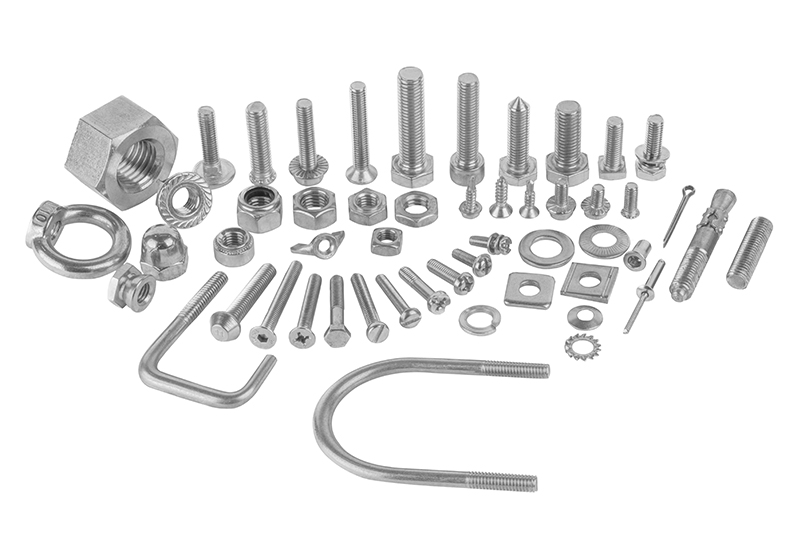
Stainless Bolt Industries Pvt. Ltd. manufactures and stores a wide variety of fasteners made of District 202 ( Shree brand), District 304 and District 316 (Sava brand) for important industrial projects. Here is our full range of products:
Different Types of Bolts & Machine Screws
Full Thread Hex Bolts (DIN 933), Half Thread Bolts (DIN 931), Allen Cap Socket Head (DIN 912), Countersunk Screws (DIN 965), Pan Head Screws (DIN 7985), and Hex Flange Bolts (DIN 6921).
Hex Nuts
Normal Hex Nuts (DIN 934), Nylon Lock Nuts (DIN 982/985), Flanged Lock Nuts (DIN 6923), Dome Cap Nuts (DIN 1587), and Heavy Hex Nuts (ASME B18.2.2).
Precision Load Distributing Washers
Plain Washers (DIN 125A), Heavy Flat Washers (DIN 9021), Spring Lock Washers (DIN 127B), Internal/External Star Washers (DIN 6798), and Conical Washers (DIN 6796).
Anchors and Hardware for Foundations
Heavy-duty Expansion Wedge Anchors, J Bolts, U Bolts ( industrial standard IS 730), and T Slot Bolts.
Fasteners and Rods of Threaded Type
Continuous Rods Threaded (DIN 976), Double-ended Thread Studs and custom-made fasteners traded as Shree and Sava.
Why to choose Stainless Bolt Industries Pvt. Ltd.?
Stainless Bolt Industries Pvt. Ltd., the best SS manufacturer in India and biggest SS dealer in Ahmedabad, makes 100% corrosion resistant fastening systems according to client’s needs. Stainless Bolt Industries Pvt. Ltd. plant uses certified raw materials conforming to ISO, ASTM, DIN, and IS standards.
All your shipping orders from Stainless Bolt Industries Pvt. Ltd. will include complete heat traceability of materials, good price for bulk purchases, and extensive Material Test Certificate (MTC 3.1) for your quality checks.
Conclusion
In conclusion, selecting between Grade 304 and Grade 316 stainless steel fasteners entails assessing operating conditions of use, risk of chemicals coming into contact with materials used, and anticipated lifetime of durability. To put things into perspective, Grade 316 is expected to provide users with significant molybdenum protection from chloride pitting in corrosive environments, while Grade 304 can be used in applications related to general construction and machinery.
For any industrial application, Stainless Bolt Industries Pvt. Ltd. is your one-stop destination for A2 and A4 certified stainless steel fasteners.
Frequently Asked Questions (FAQ)
A: Visually, Grade 304 and Grade 316 cannot be easily told apart without the stamped marking on the manufacturer’s head (for instance, A2-70 marking for Grade 304), or with sufficient chemical analysis and MTC 3.1 certification processes.
A: There is no metal which can be completely safe from aggressive chemical reactions which can take place under certain conditions.
A: In the field of engineering, it is advisable to use the same grade of fastener throughout a fastening system (such as using A4 grade nuts with A4 grade bolts), in order to avoid localized galvanic corrosion that could affect the whole joint.