
Assembly Torque Guidelines for 304 Stainless Steel Nuts and Bolts
To achieve the desired amount of clamping in various bolted structural connections, flanges, and machinery components, it is essential to comply with recommended tightening values to eliminate the potential of thread stripping or galling. Because of the special mechanical properties of 304 stainless steel bolts, it is necessary to be aware of the proper torque values when using them so as to account for the differences in yield strength and friction coefficient of 304 bolts and regular carbon steel fasteners.
Basics of Friction and Thread Galling in 304 Stainless Steel Hardware
The nickel, chromium, and molybdenum steel alloys are naturally forming an oxide layer on the surface of the steel, thus providing protection against atmospheric corrosion. However, when exposed to high pressure or rapid torque driving, the oxide layer may lose its power, causing significant friction between metal surfaces, or thread galling.
Because friction directly influences the relationship between tightening torque and clamping force, the usage of correct lubricants is critical to achieving the desired effect. The application of proper anti-seize paste, such as nickel-based, molybdenum disulfide or graphite-based one will have the friction factor lowered to the micro = 0.12-0.15.
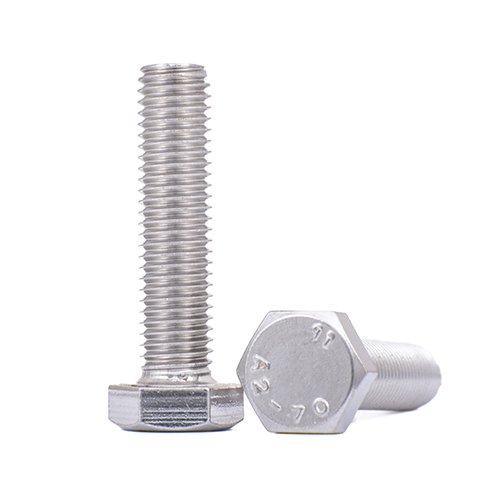
Standard Metric Torque Reference Chart for Grade 304 (A2-70) Bolts
The metrics outlined below show the suggested metric torque values for 304 stainless steel bolts (A2-70) that are tightened to around 65% to 70% of their declared yield strength while being lubricated with an anti-seize lubricant (friction factor micro = 0.12).
- M6 x 1.0 Thread Pitch: Suggested Torque = 5.2 Nm (3.8 lb-ft) | Proof Load Capacity: ~7.3 kN
- M8 x 1.25 Thread Pitch: Suggested Torque = 12.8 Nm (9.4 lb-ft) | Proof Load Capacity: ~13.3 kN
- M10 x 1.5 Thread Pitch: Suggested Torque = 25.5 Nm (18.8 lb-ft) | Proof Load Capacity: ~21.1 kN
- M12 x 1.75 Thread Pitch: Suggested Torque = 44.0 Nm (32.5 lb-ft) | Proof Load Capacity: ~30.8 kN
- M14 x 2.0 Thread Pitch: Suggested Torque = 70.0 Nm (51.6 lb-ft) | Proof Load Capacity: ~42.2 kN
- M16 x 2.0 Thread Pitch: Suggested Torque = 110.0 Nm (81.1 lb-ft) | Proof Load Capacity: ~57.5 kN
- M18 x 2.5 Thread Pitch: Suggested Torque = 155.0 Nm (114.3 lb-ft) | Proof Load Capacity: ~70.5 kN
- M20 x 2.5 Thread Pitch: Suggested Torque = 220.0 Nm (162.2 lb-ft) | Proof Load Capacity: ~89.8 kN
- M24 x 3.0 Thread Pitch: Suggested Torque = 380.0 Nm (280.2 lb-ft) | Proof Load Capacity: ~129.0 kN
(Note: Increase the torque values listed by 25% to 30% in the case of dry assembly. However, the use of anti-seize is always recommended for all of the industrial installations relating to stainless steel.)
Best Practices in Installing Fasteners To Prevent Thread Failure
Thread Cleaning and Checking
Always clean and inspect the male threads on the bolt, as well as the female threads on the nut tapping (DIN 934) for any burrs and dirt or metal shavings before beginning the fastening process.
Anti-Seize Compound Application
A thin and uniform coating of anti-seize compound should be applied on the engaged thread length and the bearing surface of the bolt head.
Manual Alignment of the Threads
In the beginning, manually turn the nut or bolt for at least 2 - 3 turns before engaging with the power tool to ensure that there is no thread misalignment.
Torque Tightening Using Calibrated Wrench
Use a calibrated manual torque wrench to tighten in the star/cross-sequencing pattern across bolts to distribute clamping load evenly.
Avoidance of Speed impact driver
High-speed impact guns generate localized heat leading to thread stripping and immediate galling.
Manufacturing of Authorized Stainless Steel Fasteners:
Stainless Bolt Industries Pvt. Ltd. manufactures hex bolts, screws (socket cap), nuts, and studs of marine-grade G316 (A4-70/A4-80) and normal grade G304 (A2-70/A2-80). Manufacturing takes places with the aid of advanced cold heading machines. These screws are produced using threading technology which provides them with smooth surface finishing. Each batch comes with the heat number and relevant MTC from the factory (MTC 3.1).